There was a time, not so long ago, when learning in school followed a much more visible and linear path. A class might move together through a textbook, page by page, chapter by chapter. A teacher's responsibility was to guide students from the beginning of that journey to the end.
As a parent, it was relatively easy to understand what was happening. A simple question, “What page are you on?” was often enough to open a window into your child’s life at school. You could look at the same book, see the same task, and offer support in a way that felt clear and direct. It was comfortable. It was easy. And it felt collaborative.
We've since learned that it wasn't very effective!
That visibility made partnership between home and school feel straightforward – and at a time when the world was changing more slowly, and student pathways were more predictable, it was a perfectly adequate way to go about the “business” of school.
Learning has changed. Teachers and learners don’t “do” the same things in 2026 as they did in 1976–no more than doctors and patients, or airline pilots and aircraft. The core business (learning) has not changed, but the context in which it operates and the knowledge base that surrounds it certainly have.
And with this change comes the reality that the nature of the home-school partnership has changed, too.
Today’s classrooms are no longer defined by a single resource or a single pathway. Knowledge is no longer scarce or contained neatly within the pages of a book; it is everywhere. When the first textbooks were designed during the Industrial Revolution, the amount of knowledge in the world was doubling approximately every 100 years. By the late 20th century, it was doubling much more rapidly. Today, some estimates suggest it may be doubling daily. In such a context, the idea that what’s worth learning can be printed in the pages of a single textbook no longer holds.
More importantly, we now understand much more about how learning actually happens in our brains. It is not a straight line from page 1 to page 100. It involves curiosity, struggle, feedback, emotion, and connection. It is less about the inputs entering the brain and more about what the brain does in response to those inputs. It looks different for different learners, even within the same classroom.
Two students can be working towards the same goal, but through different questions, different contexts, and different routes. Children are never truly “on the same page,” even when their learning is aligned with the same rigorous goals and objectives. This is especially true in the context of international schools, where students speak so many different home languages and represent so many different cultures. It is more organic and responsive, embedded in richer contexts, and centred on the meaning-making of the individual child rather than solely on the input decisions of the teacher. It is richer, deeper, and better.
But it is also harder to see at home. “Open your textbook to page 34” was so much easier.
I was reminded of this many years ago in a conversation with a parent who came to see me, frustrated that the school was no longer using a single textbook in the classroom. Her complaint was that the loss of the textbook represented a lowering of standards and a watering down of the curriculum. At the time, I remember thinking that the concern missed the point. Surely it was obvious that learning should draw from many sources, not just one. Her argument made no sense to me.
But as we spoke, I began to understand what was really being said. Although she was grieving the loss of the textbook, that was not her real question. As I asked her to explain further, I came to understand her real problem. She did not know how to help her child anymore. She used to simply turn to page 36. Now what was she supposed to do?
That changed our thinking – and our conversation – completely.
More recently, I had two parents, one Japanese and one American, come to see me after talking together in the car park. Each had assumed that the approach to learning they were seeing must reflect the “system” of the other country. When they realized that neither recognized it as familiar, the question became: What is this, and why is it different? The answer, of course, is that it is not about national systems at all. It is about the evolving nature of learning itself. Schools - if they are good schools - will not look like the places we went to as children. This is a generational shift in learning. Not simply a cultural one.
The nature of learning, however, is not the only thing that has changed since we were at school. So too has family life. The routines that once naturally supported conversation about the school day are not always as fixed as they once were. Families are busier. Schedules are more fluid. The 24/7 nature of our connected lives impacts the home as much as it does the school, and that fixed daily conversation around the dinner table is not the norm in many households as it once was. Time together can be harder to protect. None of this is negative in itself, but it does mean that the simple, shared reference points that once made it easy to talk about learning at home are less common than they used to be. Parents have to work harder to find opportunities to connect with their children around their learning.
So we find ourselves in a new place. The way we do learning has changed. The way many families operate has changed. But we still love our children and want to support them; schools and homes still need, more than ever, to help one another in that task.
This is our shared challenge.
As a school, we know that we need to continue improving how we communicate learning, not just what students are learning, but how that learning is happening and why it looks the way it does. At the same time, we need to support our parents in understanding how these differences affect how they can help their children, knowing that this may mean doing things differently from how they were supported growing up.
Instead of asking “What page are you on?”, the kinds of questions that open up learning today are different. What made you curious today? What did you struggle with? What are you getting better at? What is something you are proud of? These are not questions that point to a single answer or a single task. And you won’t find a textbook page to help you. But these questions invite children to reflect, to explain, and to make sense of their own learning, and they can open up powerful conversations that allow parents to support their children in deeper and more meaningful ways.
Many years ago, when my son was in Grade 5, one such conversation led to a 30-minute maths investigation. He was wondering about addition and multiplication, and we started using maths to work out how many people could be seated in a room. Then we added more variables: How big are the people? Do they all have to sit? Can we change the furniture? It became a rich discussion about maths in context. I wasn’t helping him with page 32, but I was helping him with his maths.
What should reassure us is not always the neatness of what we can see, but the quality of what we can hear. How are our children having conversations? Are our children asking questions? Are they making connections? Are they willing to take risks, to struggle, and to try again? And how can we truly hear them and join them in their journey?
We need to let go of some expectations that belonged to a different era. The idea that learning will always follow a fixed sequence, that progress will always be immediately visible, that understanding can be captured fully in a single test score or outcome, or that every detail of every lesson can be mapped in advance. In their place, we look for something more complex, but also more meaningful: growth in understanding, in skill, in confidence, and in the dispositions that will enable young people to continue learning long after they leave school.
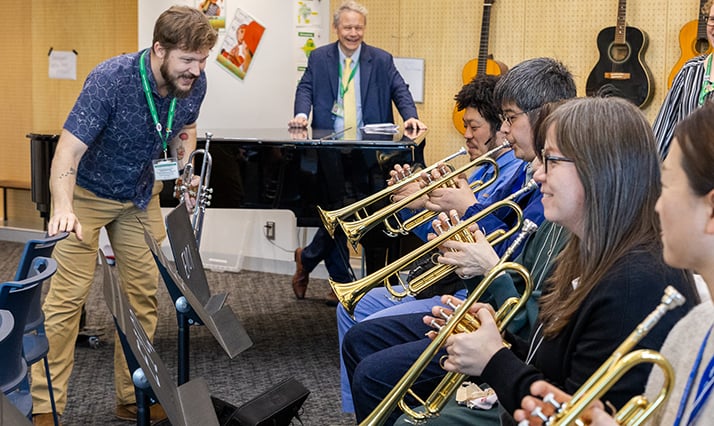
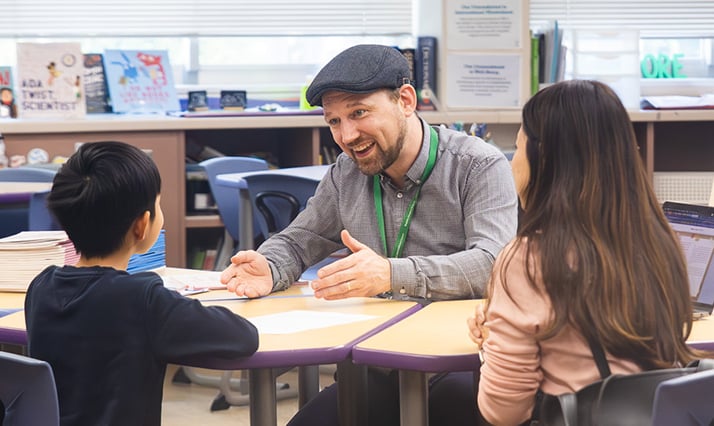
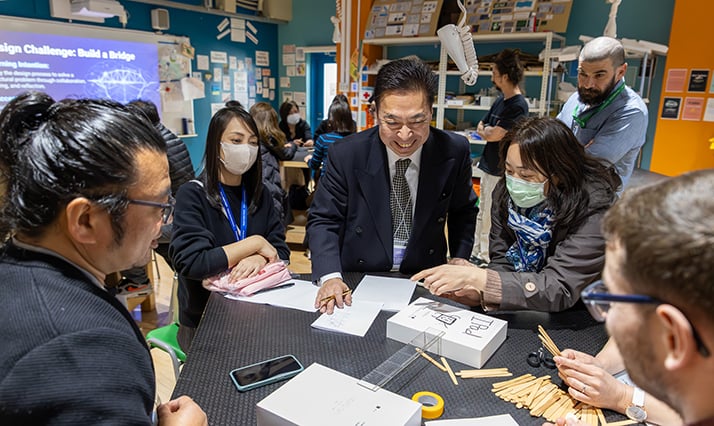
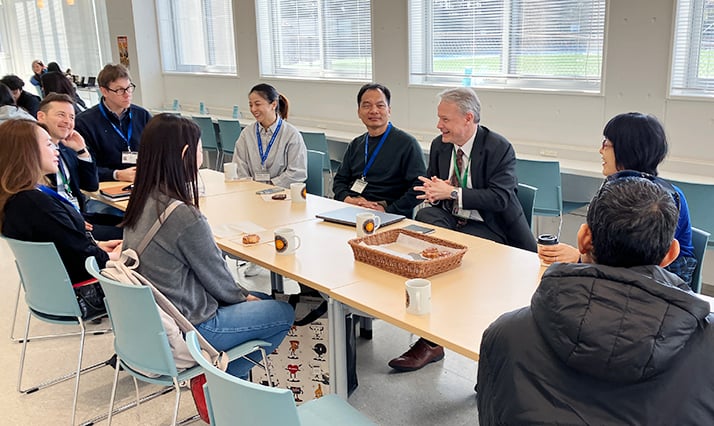
Early this month, we were excited to welcome so many parents into school to be ‘learners’ for an afternoon. Watching parents sitting in classes for Math, Music, Design, Science, Japanese, and more was a powerful connecting experience. Learning really is different from when we went to school, and building a shared understanding helps us all – parents and school – work together in support of the learning of each and every child.
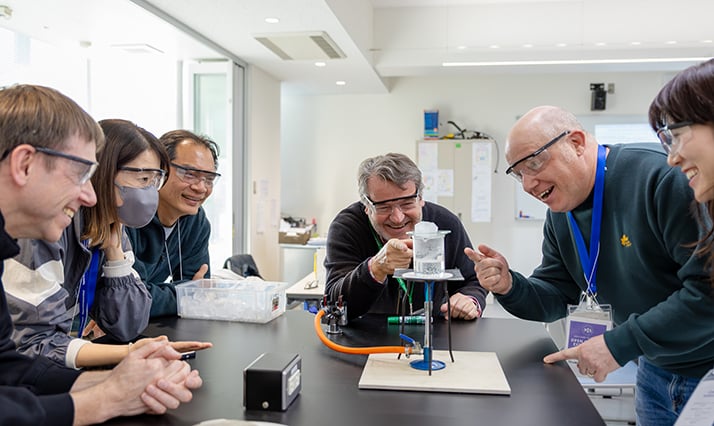
At NIS, we hold firmly to the belief that parents are a child’s first teacher. Our role as a school is to bring professional knowledge, experience, and intentional design of learning for the child. The role of parents is to bring deep knowledge of the child — their identity, their values, their world beyond school. When these come together, the partnership is powerful.
This partnership can be so much more meaningful than “open your textbook to page 32”. Because learning is no longer about making sure you are on the right page. It is about getting our students to write their own book!
